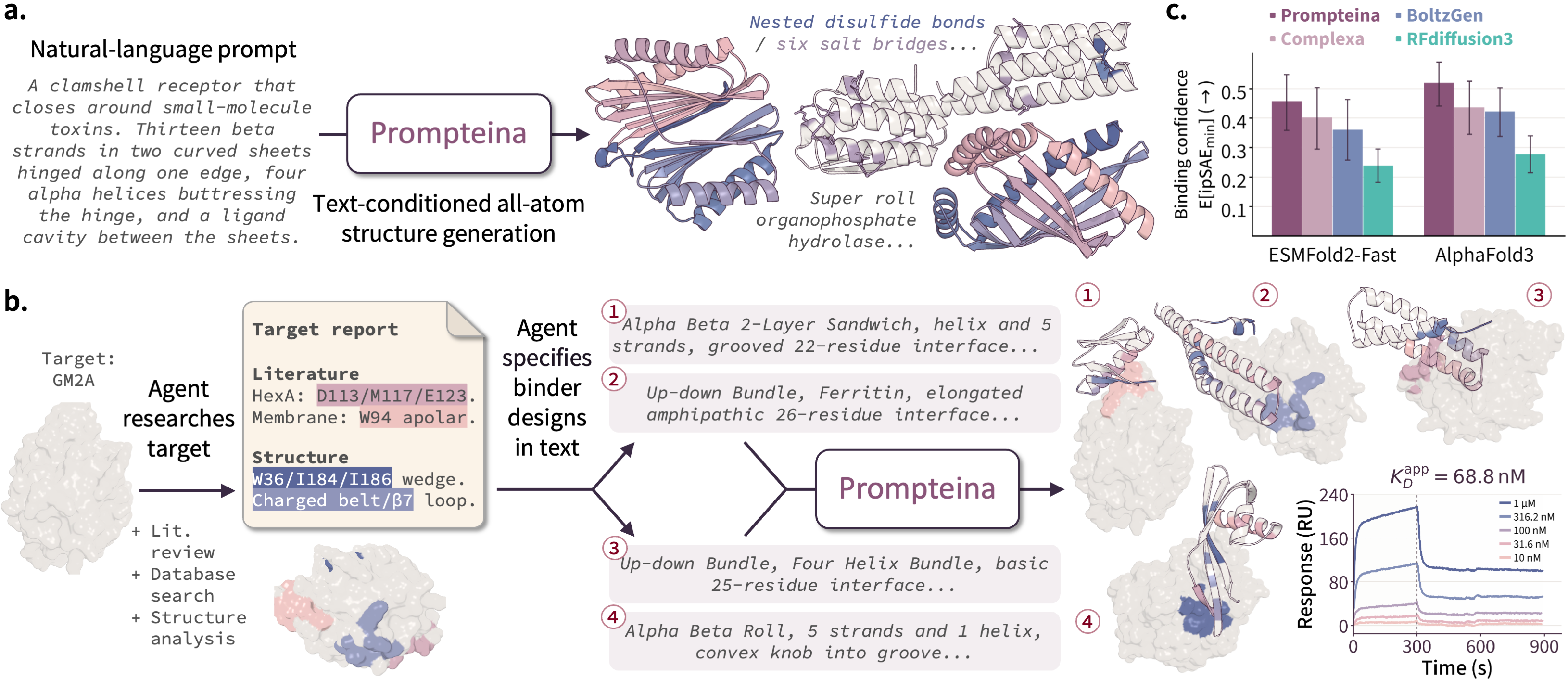
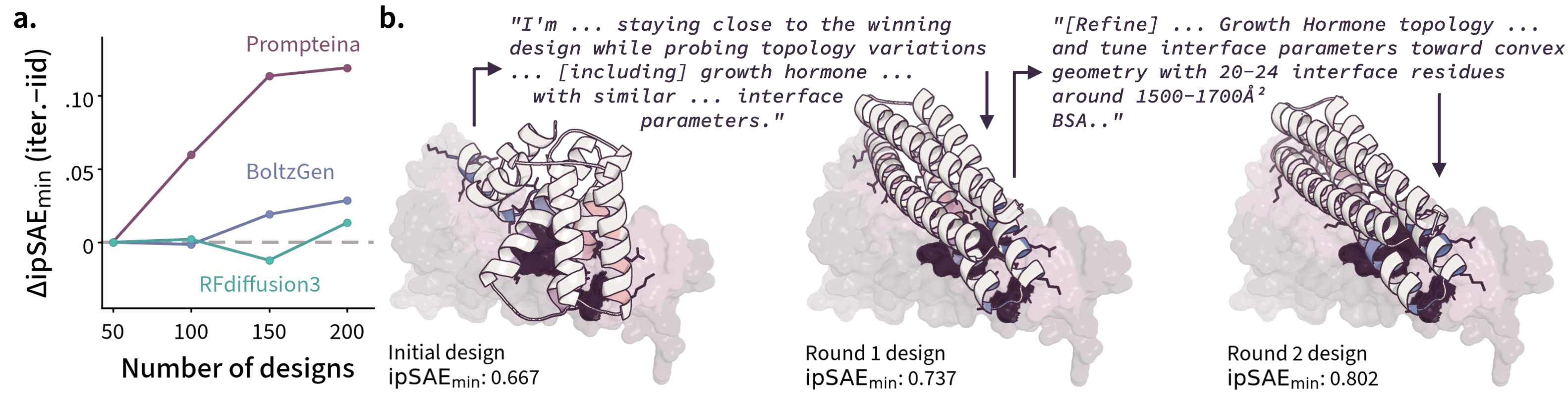
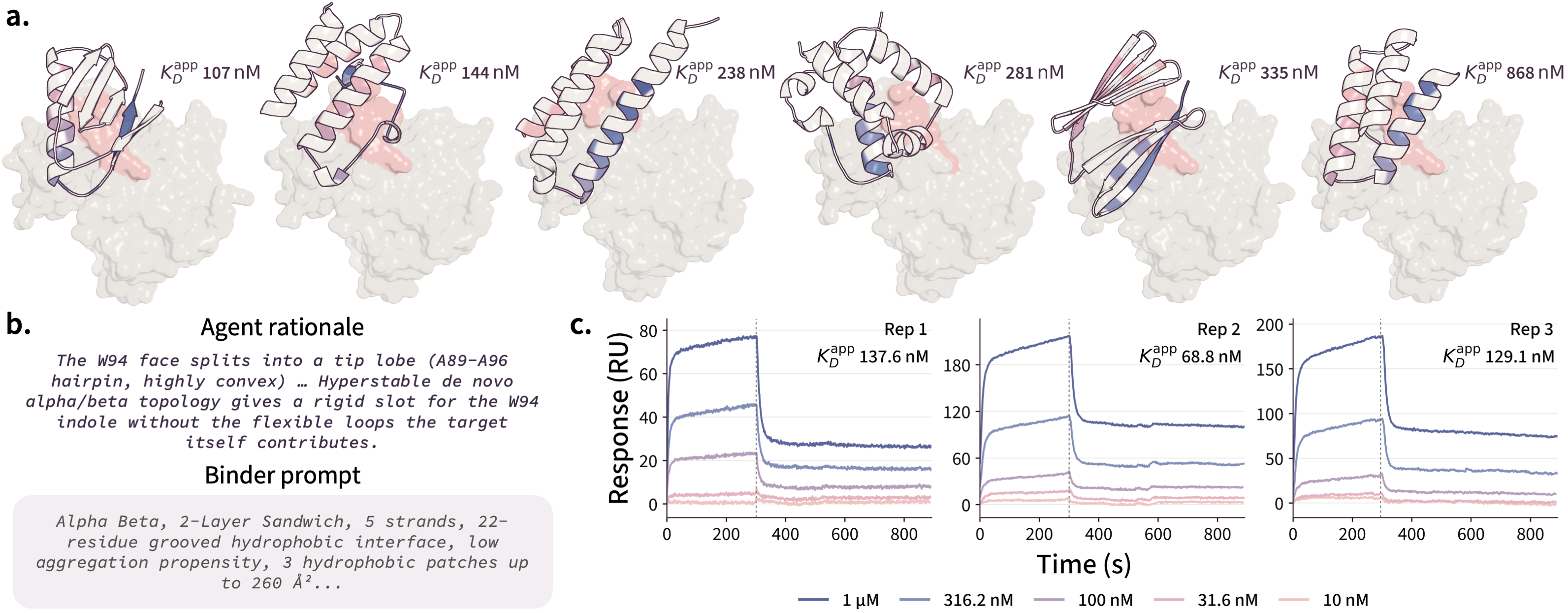
Prompteina provides a unified natural-language interface for protein structure design, directly conditioning the denoising process on text representations. In binder design, it translates biologically informed specifications into diverse candidates with higher predicted confidence than those generated by existing baselines and yields experimentally validated binders.
Prompteina is a text-conditioned all-atom protein structure generation model that takes as input a natural language prompt and generates an all-atom structure. Using a single natural language interface, Prompteina specifies desired structural and functional properties of generated proteins. This includes but is not limited to:
- Fold and topology: CATH class and architecture; ECOD architecture and groups
- Multi-domain proteins: domain count, order and per-domain CATH class or architecture
- Secondary structure: the number of helices, strands and sheets, and the sheet topology
- Tertiary motifs: the number of disulfide bonds and salt bridges
- Global shape: size, compactness, symmetry, contact order, flexibility
- Surface properties: planarity, spatial aggregation propensity, buried unsatisfied polar groups
- Interface: the number of interface residues, buried surface area and interface geometry
- Function: a family or activity, such as a lysozyme or a green fluorescent protein
Prompteina currently supports monomer and protein binder design, enables seamless integration with agents in design campaigns, and has been experimentally validated: against GM2A, a protein implicated in GM2 gangliosidosis and with no previously reported de novo binders, Prompteina yielded nine binders from 90 designs tested. We also constructed Prompteina-Data, the paired text–structure dataset used to train Prompteina, comprising 1.8 million protein-structure entries and 52.4 million natural-language captions. We are preparing the dataset for public release. It will be available shortly.
Our work builds on open models and data resources, including Proteina–Complexa, Qwen3, the Protein Data Bank, the AlphaFold Protein Structure Database, CATH, ECOD, and UniProt. We thank their developers, contributors, and maintainers for making these resources openly available to the research community.